Vision Solutions and Inspection
AI vision inspection that checks every part at line speed and tells your PLC what to do with it. HA-TEC builds on Adente Vision, our technology partner, and takes care of everything around it: mounting, lighting, robot and PLC integration, and commissioning on your line.
Technology partner
Built on Adente Vision
Adente Vision combines camera, lighting, edge computer and software in one system. The AI model runs on the unit at the line, so each part gets a decision in about 30 ms without sending production images to a cloud.
HA-TEC brings the integration: we fit the system into paint shops, body shops and assembly lines, program the robot side, connect it to your controller and commission it on site.
Visit vision.adente.ai ↗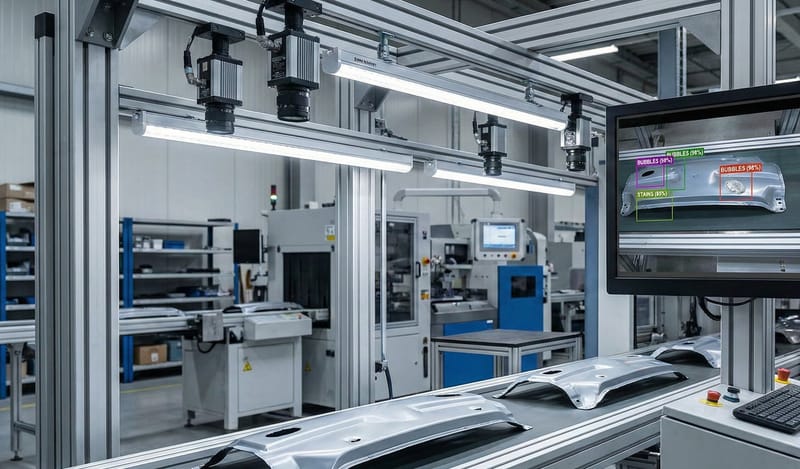
- Measurement precision
- 0.01 mm
- Decision time per part
- ~30 ms
- Parts per minute
- 100+
- Good parts to train a model
- ~20
- Global-shutter camera, up to
- 12 MP
Five inspection modes
One platform for every check on the line
All five modes run on the same hardware and software, so a second check on the same station is a software change, not a new system.
Anomaly and defect detection
Trained on good parts only, it flags anything that deviates: scratches, dents, cracks, burrs, paint and coating faults, contamination.
Assembly and missing part
Confirms screws, clips, connectors, seals and labels are present and seated before the part moves on.
Code reading
Reads barcodes, data-matrix and QR codes, dates, lot codes and serial numbers, and links each code to the part result.
Measurement
Gauges edges, profiles, gap and flush, and hole positions to 0.01 mm against your tolerance.
Part identification
Recognises variants, orientation and colour, and hands the controller a program-select code with a confidence score.
Configurator
Find the right vision setup for your part
Answer five questions and we will show you which inspection mode, camera, lighting and PLC link fit your application, and why. The result is a starting point for a trial on your own parts, not a binding specification.
Your vision setup
Answer all five questions to see your setup.
It chooses between
Anomaly and defect detection
Trained on good parts only, it flags anything that deviates. Known defect classes are reported by name.
Assembly and missing part check
Confirms every screw, clip, seal and label is present and seated before the part moves on.
Code reading (OCR and barcode)
Reads and verifies barcodes, data-matrix and QR codes and printed text at line speed.
Measurement
Gauges geometry, features and hole positions to 0.01 mm against the tolerance you set.
Part identification
Recognises the variant in front of the camera and sends the controller a program-select code.
How a project runs
From sample part to running line
Send a part, or we come to you
A short call about the part and the defect, then sample parts or a visit to your line.
The model learns your part
About 20 good parts are enough to train it. Training takes less than 48 hours.
See the result on your own parts
You see the catch rate on your parts before you receive a quote.
HA-TEC installs and commissions
Mounting, lighting, PLC and robot integration, and operator training on site.
Integration
Speaks your PLC's language
Every trigger returns a pass/fail result and a reject signal to the controller over PROFINET, EtherNet/IP, EtherCAT, Modbus TCP, OPC UA or digital I/O. Setup, mode changes and re-teaching happen at the line in Adente Vision Studio, without a vision specialist on site.
Applications
Vision in the paint shop and body shop
Defect Detection Systems
AI inspection trained on good parts that flags paint faults, scratches, dents and contamination.
Learn more →Sealant Bead Inspection
Gap, break, width and position checks on every seal, linked to the sealing robot for repair.
Learn more →Automatic Part Detection
Variant recognition and program selection for mixed-model lines, with code reading.
Learn more →Part Position Mapping
Feature positions measured to 0.01 mm and passed to the robot for path correction.
Learn more →FAQ
Frequently Asked Questions
What types of defects can machine vision detect in paint shops?
HA-TEC vision systems detect surface defects including runs, sags, craters, dirt inclusions, scratches and colour deviations. The model is trained on good parts and flags anything that deviates; known defect types are reported by name. Before we quote, you see the catch rate on your own parts.
How does automated sealant inspection work?
Our sealant inspection systems use laser triangulation and camera technology to verify bead width, height, position, and continuity in real-time. Any deviation from specifications triggers an immediate alert, preventing defective parts from proceeding.
Can vision systems be added to existing production lines?
Yes, HA-TEC vision systems are designed for retrofit installation. Cameras and lighting mount on existing structures or next to a robot cell, and results go to your existing PLC over PROFINET, EtherNet/IP, EtherCAT, Modbus TCP, OPC UA or digital I/O.
How many sample parts do you need to train the system?
About 20 good parts are enough to train a model for defect detection or assembly checks. You do not need a collection of bad parts. Training takes less than 48 hours, and the model can be re-taught at the line when a new variant arrives.
What is the ROI on machine vision quality control?
Typical ROI is achieved within 12-18 months through reduced rework, fewer customer complaints, and lower warranty costs. Manufacturers commonly see a 40-60% reduction in quality-related costs after implementing automated inspection.
We are looking forward to assist you!
Would you like to discuss a new project, request a consultation, or learn more about our automation solutions? Just contact us!
HA-TEC System GmbH
Erika-Naumann-Straße 4
71063 Sindelfingen
Germany